Software
Continuum Core
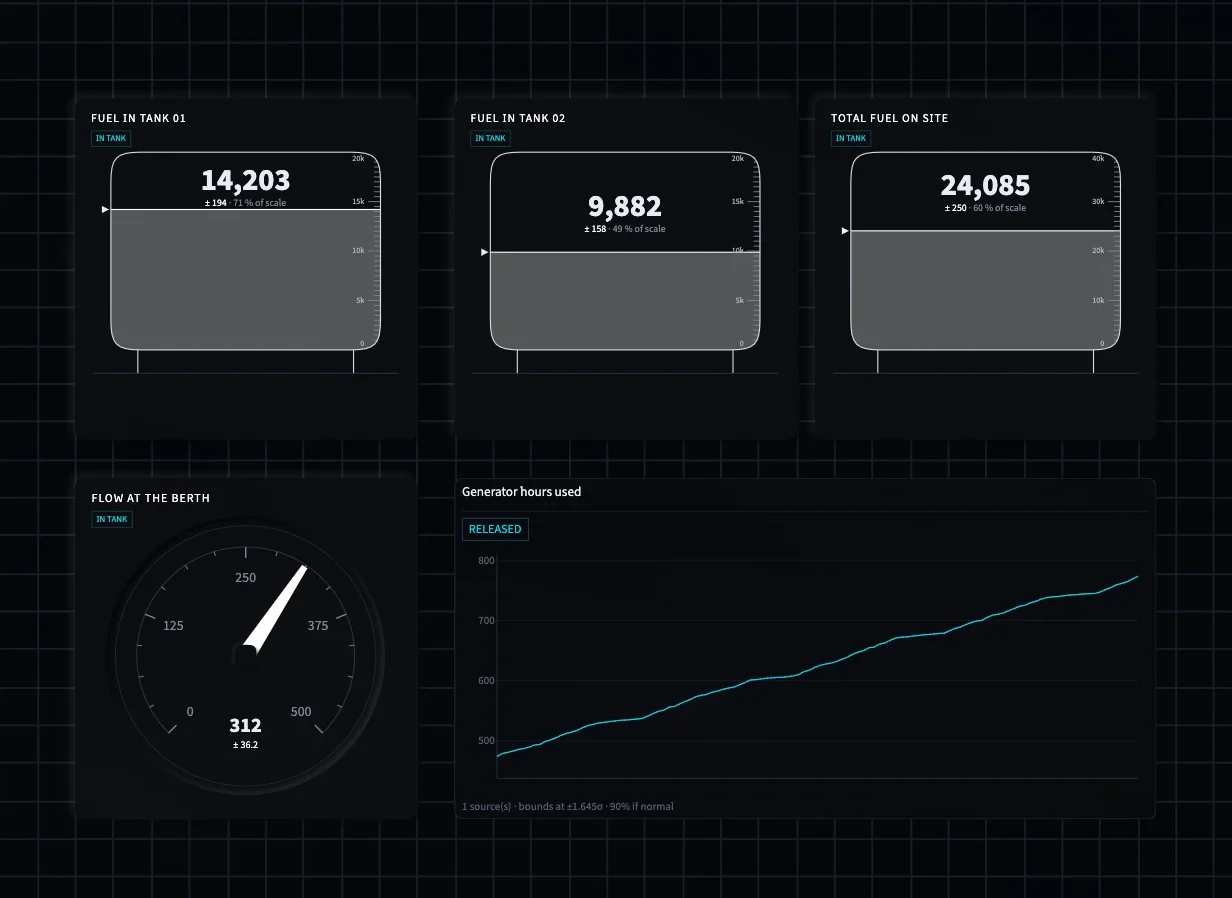
The operating system. It connects to the systems you already run and links every tank, machine, movement, contract and cost. Each team works on its own and sees the moment something it depends on changes.
Explore Core
Terrafa is the intelligent operating system for energy businesses, with its own sensing hardware. Every team works independently but stays connected to the others. We start with fuel and build for all of energy, commodities and defence.
One team designs all four parts together.
The operating system. It connects to the systems you already run and links every tank, machine, movement, contract and cost. Each team works on its own and sees the moment something it depends on changes.
Explore Core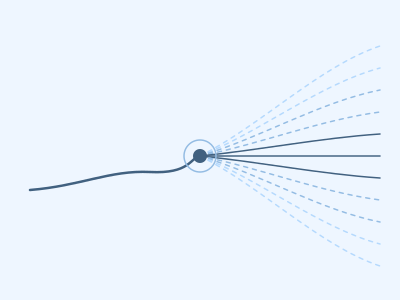
Our family of physics and engineering models. It forecasts how product and plant will change, and it prices every option before you choose.
Explore Gamma
Agents do the routine work inside Core within your rules. A person releases every change and can take over at any time.
Explore agents
Our AI-embedded hardware, built on infrared spectroscopy and graphene. It reads the product in tanks, pipelines, plant intake and process lines, and every reading goes straight into Core.
Explore SenseTerrafa designs its AI-embedded hardware alongside Core and Gamma, so what happens inside a tank or a plant reaches every decision the business makes.
| Reads | Liquids, solids and gas. |
| Where | Tanks, pipelines, plant intake and process lines. |
| Built on | Infrared spectroscopy and graphene. |
| Certification | ATEX certified, with UKEX and IECEx under way. |
| Research | Biodiesel content in diesel read on site in seconds, within 0.16% v/v of the ASTM D7371 laboratory method. |
| Patents | Pending in the UK, Europe and North America. |
| Fitting | Terrafa engineers fit it with no shutdown. |
| Service | Terrafa looks after it for its working life. |
| Next | Lubricants, jet fuel, biofuel blends, coolants and transformer oil. |
Commercial and finance teams see how much product sits at every site, its condition and its value. They sell and borrow on today’s position.
You see what each choice earns and costs, in pounds per tonne, before a blend or a sale goes ahead.
Teams see product nearing its limit or a machine wearing out days or weeks ahead, with the job and its cost attached.
AI agents prepare nominations and duty returns within your rules, and a person releases every change.
Terrafa connects to your control, laboratory, terminal, trading and finance systems, and your teams keep working the way they do today.
Each team keeps its own work and sees what the others see on the same day.
Live since March 2026 at a European fuel trading and distribution group. Boiler efficiency up 3.1 points at a multi-site bioenergy generator.
An energy group holds product in tanks across several sites. Its lab, traders, operations and finance teams each work in their own system. When a tank starts to age, the lab knows first, and the traders often hear about it days later.
The traders see what the lab sees on the same day, along with the tank’s value and how long it will stay in specification. They sell that tank first, while it is worth the most.
AI agents prepare the routine work, such as nominations and duty returns, and a person releases every change.
Terrafa is for businesses that run physical operations across many sites in energy, new energy, commodities and defence: oil and gas, refining and blending, storage and terminals, distribution and trading, power and data centres, renewables and bioenergy, hydrogen, ammonia and methanol, sustainable aviation fuel, agriculture and food, metals and mining, and defence. Fuel is where we start. In each of these businesses the most valuable decisions cross teams. Whether a product is sold, held, blended or treated depends on the lab, operations, the traders and finance together. Each team works in its own system, so these decisions are made late, and the cost shows up as product sold below its value, quality claims, stock the bank will not lend against, and trucks and ships kept waiting. Terrafa connects the teams, so decisions are made earlier and priced before they are taken.
You agree one figure for the year and draw on it for software and hardware as you add sites.
Whatever you do not use carries into the next year.
See how Flex worksTell us about your sites and an engineer will come back to you.