/Product

One operational model. Four surfaces. One physical foundation.

Continuum connects what an operation holds, owes and owns with the market it operates in, into one governed account. Each surface answers a different question and all of them run on the same model.

/Continuum Core

The operation on one record

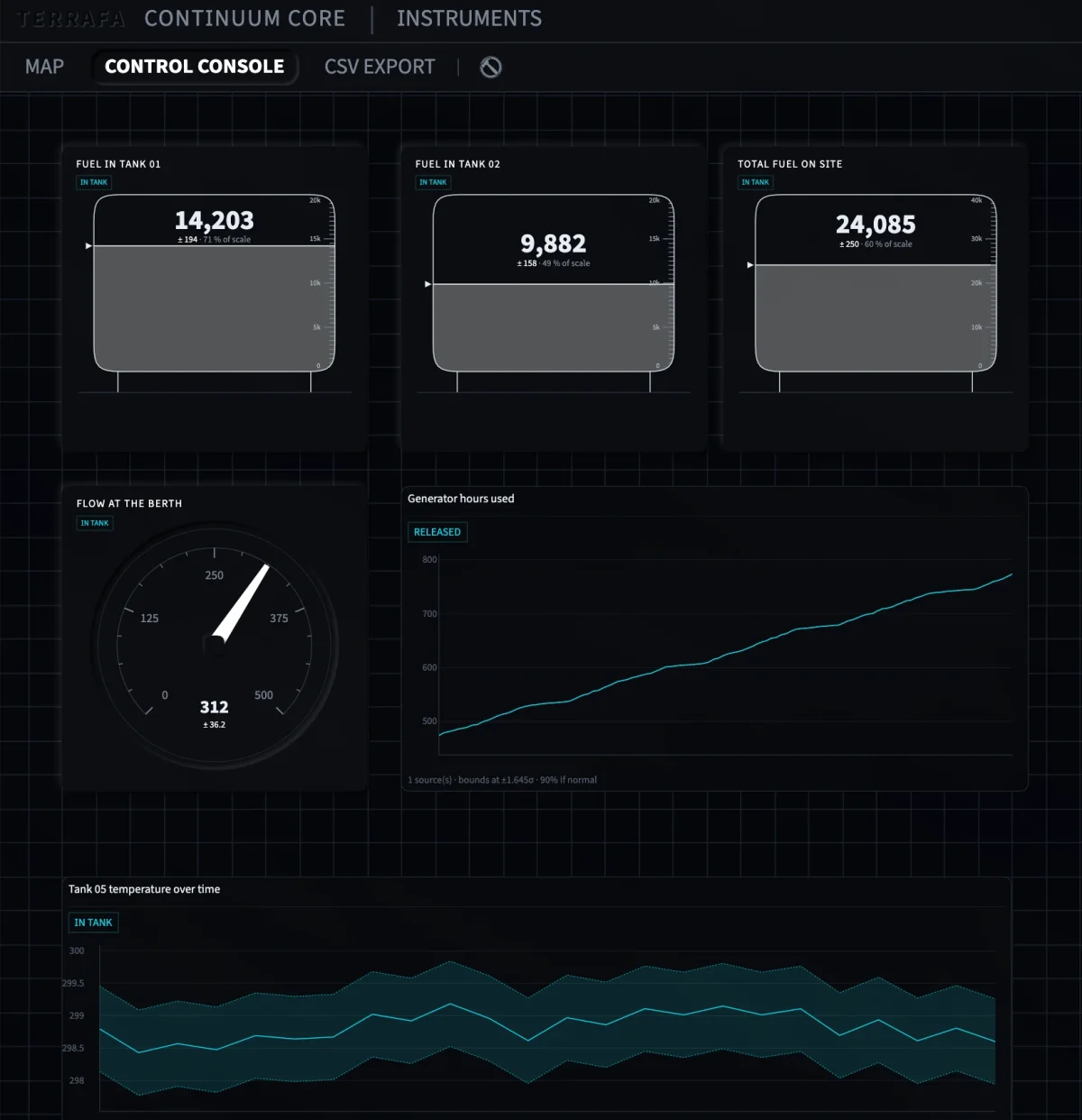
Core runs the whole of a commodity operation on one account: receipt, gate access, storage, transfer, blending, loading and dispatch, held together with the orders behind them, the contracts they satisfy, the duty they create and the cash they tie up. Every mode of transport, road, rail, marine and pipeline. Planned and unplanned orders alike.

Every figure is composed from its inputs with its origin on record, so an audit becomes a lookup rather than a reconstruction.

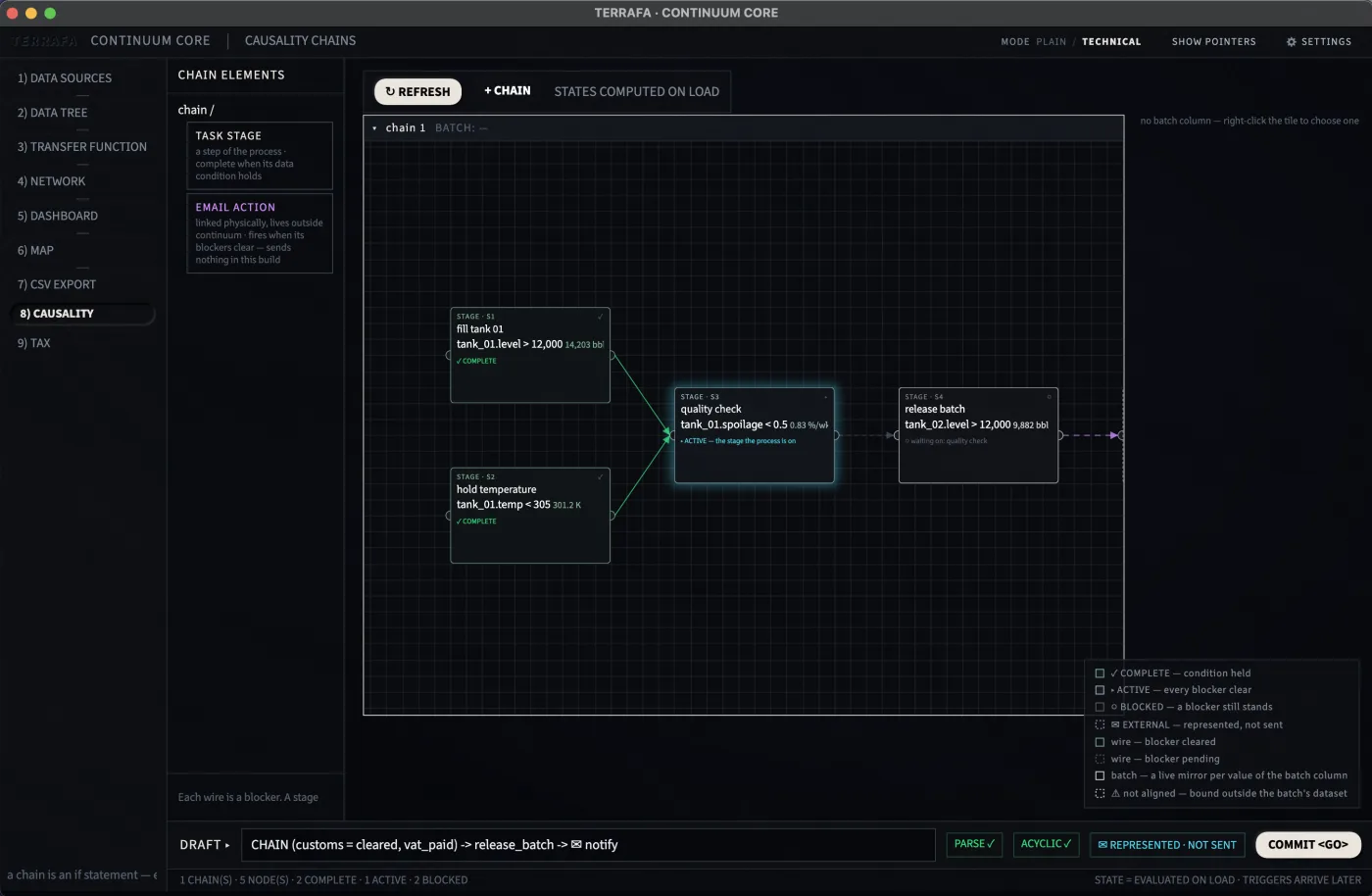
Continuum Core · Causality chains Chain 1 · Live
Continuum Core causality chains: four stages wired into a chain, two complete, one active and one blocked on the quality check ahead of it, with the draft chain expressed as a statement along the foot of the screen.
A chain is an if statement over the operation’s own record. Each wire is a blocker, and a stage completes when its data condition holds.
/Operating tools

What runs on the model from the first day.

Terminal operations

  • Product receipt and intake
  • Gate access and vehicle movement
  • Bay, jetty and loading area
  • Storage and tank assignment
  • Transfer and outturn
  • Movement scheduling
  • Shift handover and end of day
  • Alarms and events

Assets and equipment

  • Tanks, bays, jetties and lines
  • Meters and gauging
  • Vessels, wagons and trailers
  • Pipelines and manifolds
  • Asset state and availability
  • Capacity against nomination
  • Maintenance windows in the plan

Inventory and custody

  • Book stock against gauged stock
  • Ullage and headroom
  • Interface settlement
  • Loss attribution by movement
  • Folio reconciliation
  • Custody transfer

Product quality

  • Specification and giveaway
  • Blend to what the contract owes
  • Condition through storage
  • Valuation by condition
  • Testing directed by exposure
  • Off-spec exposure

Commercial and contracts

  • Nomination against actual lifting
  • Product transfer agreements
  • Exchange agreements
  • Counterparty performance
  • Claims and disputes
  • Demurrage exposure

Duty and compliance

  • Duty as the movement creates it
  • Customs and warehousing status
  • VAT on duty-inclusive value
  • Ownership per parcel and owner
  • Duty-suspended movement and e-AD
  • Loss allowances and assessment
  • Origin and preference

Working capital

  • Borrowing base and eligible stock
  • Working capital held in inventory
  • Cash per parcel
  • Obligation as a funding line
  • FX by leg
  • Draw preparation
  • Position by business unit

The model

  • Object types and links
  • Actions that change them
  • Derivation on every figure
  • Confidence propagated
  • Event log and lineage
  • Access control and roles
  • Versioned rulesets
/Continuum Vectis

The forward view, from the operation’s own record

Vectis forecasts requirement, availability, cost exposure and obligation from what the operation has actually done, read against prices, freight and flows. It prices a commitment against the physical position, the contract, the duty and the cash together rather than within one function.

Scenarios chain across the whole operation, from intake through transformation to sale and settlement, and every scenario and its outcome is captured and carried into the next. Because the forecast is calibrated against the operation’s own history, the record of what was predicted against what happened is part of the account.

/Continuum Reach

The record, opened outward

Reach extends the same account to everyone who acts on it. Customers see their product and their movements. Counterparties resolve differences against a shared record instead of exchanging claims. Lenders and treasury work from a position the operation can demonstrate rather than assert.

And the systems acting on the operation’s behalf, its analysts, its spreadsheets and its agents, are served the same values with provenance attached, scoped per party and per caller.

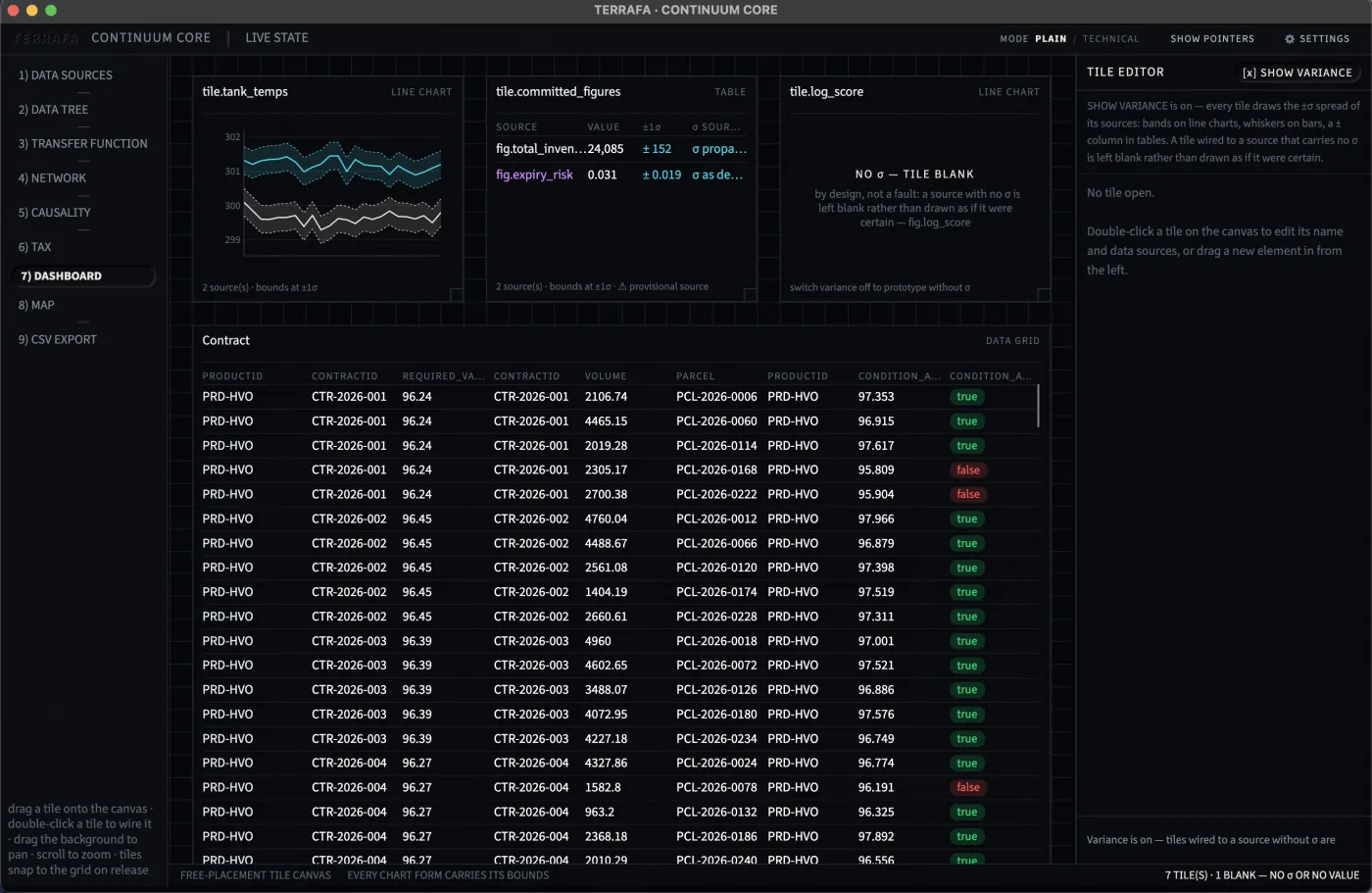
Continuum Core · Live state 7 tiles · Live
Continuum Core live state: dashboard tiles wired to their sources, each drawing the plus or minus one sigma spread, one tile left blank because its source carries no sigma, above a data grid of contract rows.
The same account, served as a view. Every tile draws the ±1σ spread of its sources, and a tile wired to a source with no σ is left blank rather than drawn as if it were certain.
/Continuum Sense

The physical foundation, laid in as a service

Sense establishes composition and condition where the product sits, across liquids, solids and gas, at intake, in storage, at transfer, at the point of blending and at the fiscal boundary. It runs alongside the accredited testing standards require, never in place of it.

READS

Composition and condition of the product, in place and continuously.

PHASE

Liquids, solids and gas.

POSITION

Intake, storage, transfer, blending, fiscal boundary.

ATTACHMENT

Existing port, hatch or side stream. No line entry.

ENVIRONMENT

Rated for flammable atmospheres.

REFERENCE

Sample and reference read together, so drift is visible.

CALIBRATION

Held and maintained by Terrafa, traced to accredited method.

OUTPUT

Every value carries its origin and its confidence.

SUPPLY

Per reading point, per year, operating expenditure.

/AI and the operational model

From advanced analytics to agents, on a foundation worth acting on.

AI sits as the keystone, not the foundation. Use and hone deterministic tools built upon a reliable data plane and composable with natural language. Guide an agent to make routine decisions with a human executing the critical operations.

Machine learning

  • Degradation and condition through storage
  • Loss pattern detection by counterparty and shift
  • Yield and blend optimisation
  • Demand and lifting behaviour

Hybrid AI

  • Machine learning where appropriate
  • Symbolic AI for proces management
  • Scenario chaining across the operation
  • Boundary prices and merit order

Generative AI

  • Natural language across the account
  • Automated preparation and reporting
  • Answers traced back to their inputs
  • Human in the loop for the decision

RLHF

  • Make decisions under uncertainty
  • Constantly improving policy (or off-policy)
  • MCP interfaces with guardrails built in
  • Declining when values do not support the call

The industry agrees on the obstacle

Without accurate context, AI-driven insight is unreliable or misleading, and most AI projects fail because the data underneath was never ready. The answer everyone is building is to ground the model so it cannot invent an answer.

Grounding is only half of it

Grounding stops a model making something up. It does not make the answer true. Every foundation in this market is assembled from values that were entered, certified or observed at a distance.

What Continuum serves

Every value crosses with where it came from and how sure it is, so a system reasoning on the record knows when to act, when to check and when to stop. A person signs anything that commits capital.

/Connect

Continuum sits on the systems the site already runs.

Plant and terminal

  • PI and other historians
  • Terminal automation systems
  • Tank gauging and metering
  • OPC UA, Modbus TCP, MQTT

Business systems

  • ERP and SAP
  • LIMS
  • ETRM and the trading book
  • Access control and gate systems

Documents and filings

  • e-AD and ARC
  • Certificates and bunker notes
  • File, mailbox and SFTP
  • No-code flows already in place

Answers out

  • Excel add-in
  • REST API and webhooks
  • Scheduled warehouse drop
  • Agent interface
/Continuum Start

Proof on your own history first

Before anything is committed, we run Continuum against what the operation has already done and show what it would have shown. A working instance and a back-test on your own record, with no sales call required.

/Continuum Flex

Agree one figure for the year. Spend it as you go.

Most software makes you decide everything up front: how many sites, how many users, how many reading points. Change your mind and you start a new purchase.

Flex is one annual agreement. You draw against it for whatever you need, whether that is the platform, extra reading points on a tank, bringing a second terminal onto the system, or help from our team. No new purchase order, no new approval. Whatever you have not used carries into the following year.

Speak with someone who has run one.

Connect with the Terrafa team to see Continuum on your own operation.